
Industrial Cleaning Machine Selection Guide: Scrubber Dryers, Sweepers and Vacuums
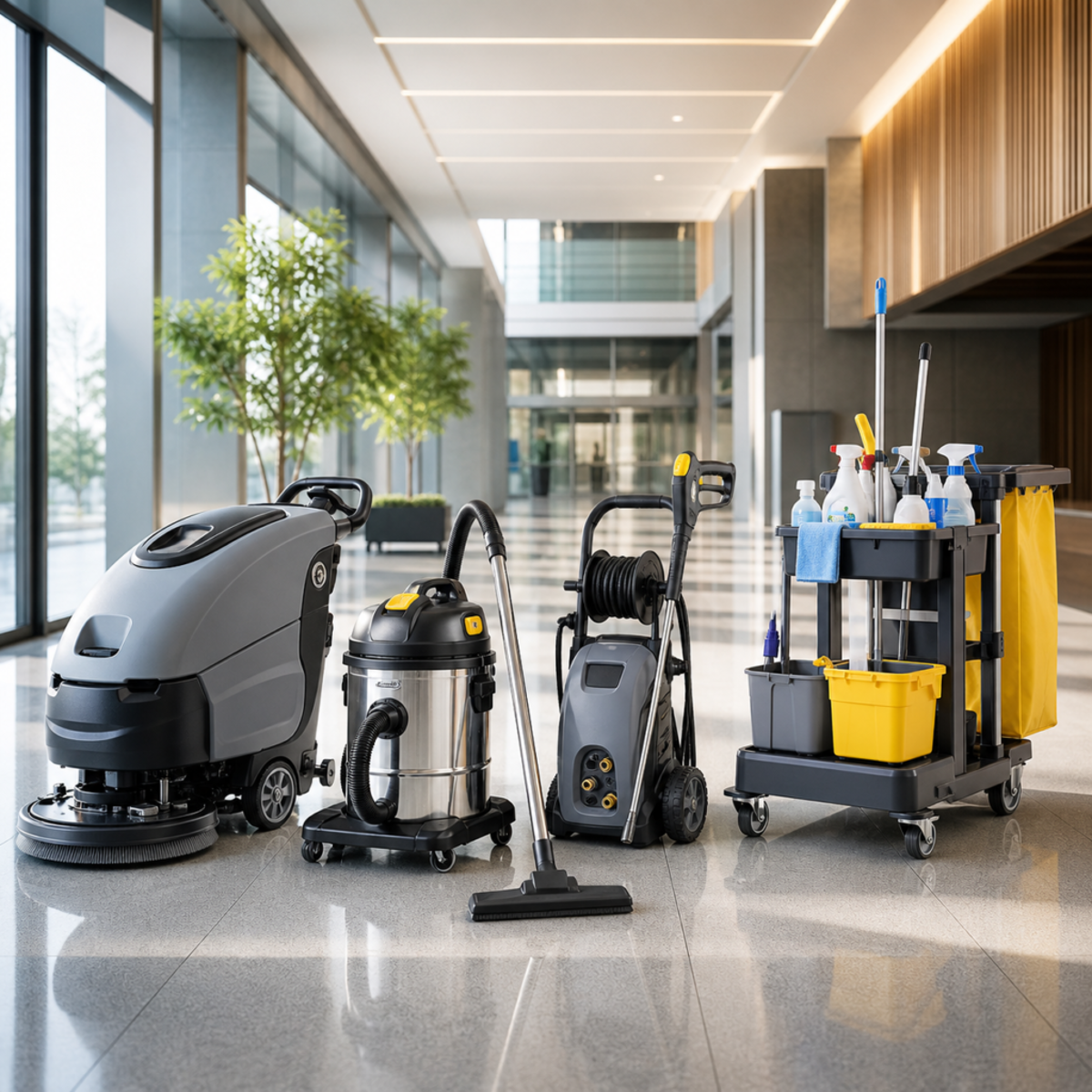
How to calculate cleaning capacity in square metres per hour, compare walk-behind and ride-on scrubber dryers, choose brush pressure, tank size and battery type, and weigh a new machine against a used one before buying.
One number decides an industrial cleaning machine purchase: square metres cleaned per hour. Catalogue figures fall to about 60-70 percent in practice once turning, tank filling and obstacles are counted, and capacity planning must use that realistic value.
Machine Types and Where They Fit
Scrubber dryers wash, scrub and dry hard floors in a single pass. Walk-behind models with 400-800 mm working widths deliver 500-1,500 m² per hour, while ride-on machines with 800-1,500 mm widths reach 3,000-6,000 m² per hour. Sweepers collect dust and coarse debris and suit warehouses, production areas and outdoor yards. Industrial vacuums handle swarf, dust and liquids, and the filter class (M or H) is chosen according to the hazard class of the dust.
Capacity and Energy Classes
| Machine | Working width | Practical capacity | Tank volume | Energy |
|---|---|---|---|---|
| Walk-behind scrubber | 430-600 mm | 500-1,200 m²/h | 40-70 L | 24V battery |
| Ride-on scrubber | 800-1,300 mm | 3,000-6,000 m²/h | 100-240 L | 24-36V battery |
| Walk-behind sweeper | 550-800 mm | 2,500-4,500 m²/h | 30-60 L hopper | Battery or petrol |
| Ride-on sweeper | 1,000-1,600 mm | 6,000-12,000 m²/h | 60-180 L hopper | Battery, diesel, LPG |
| Industrial vacuum (3 motor) | - | - | 50-100 L | 3-4 kW |
Used Cleaning Machine Checklist
- Read the hour meter; 1,500-3,000 hours is mid-life for a professional machine.
- Ask for battery manufacturing year and last capacity test; the battery is the single largest cost item.
- Run the brush motor and suction turbine and check noise and current draw.
- Inspect squeegee blade wear and drying performance; wet streaks mean worn blades or weak suction.
- Check clean and recovery tanks for cracks, odour and scale build-up.
- Confirm the charger matches the machine and works correctly.
- Clarify whether spare brushes, pad holders and filter sets are included.
Kärcher, Nilfisk, Tennant, Hako, Comac and Dulevo are the manufacturers most commonly encountered, and parts availability keeps their used values strong.
Cost Per Square Metre
Labour time is the largest cost in cleaning. Cleaning 5,000 m² by hand versus with a ride-on machine is roughly a threefold difference in time for the same result. Other items are electricity or fuel, chemicals, brushes and squeegee blades, battery depreciation and scheduled service. Brushes typically last 400-800 hours and squeegee blades 150-300 hours. Chemical dosing systems can halve chemical cost.
For outdoor, road and site cleaning, see road sweepers under forestry and grounds maintenance machinery, and for waste handling see environmental and recycling machinery.
Floor Type, Brush Pressure and Chemicals
Cleaning performance is tied directly to floor type. Smooth surfaces such as epoxy and marble need low brush pressure and pads; concrete, tiles and textured industrial floors need high brush pressure and stiff bristles. Machines with adjustable brush pressure can serve different areas, which is valuable flexibility in a multi-zone facility.
Chemicals also follow the floor. Alkaline cleaners suit oily production areas, acidic cleaners suit lime and mineral deposits. The wrong chemical dulls the floor coating over time or attacks grout. Automatic dosing systems cut chemical consumption by 30-50 percent and remove the risk of incorrect mixing.
Cylindrical brush machines can pick up coarse debris and small waste that disc machines leave behind, which is why they dominate production areas. Disc machines apply better scrubbing pressure on flat floors. Specify the machine for the hardest part of the area to be cleaned; a machine chosen for the average will fail in the dirtiest zone.
Charging and tank limits belong in the sizing decision too. A machine whose battery cannot sustain three hours of continuous work will stop mid-shift in large areas. Likewise, if the clean water tank cannot cover a full cleaning round, refill stops noticeably shorten effective working time.
Several safety items also deserve attention. Look for wet floor signage, reversing alarms, seat belts on ride-on machines and operator presence sensors. Chemical safety data sheets and personal protective equipment for staff are asked about directly during inspections. Operator training matters as well, because a badly used machine damages both the floor and its own mechanical components.
New or Used?
For cleaning machines, daily usage decides. Above four hours a day, the warranty and battery advantages of a new machine dominate; for a few hours a week, a well-kept used machine is a comfortable choice.
| Criterion | New machine | Used machine |
|---|---|---|
| Initial investment | High | Substantially lower |
| Lead time | 8-30 weeks after order | Usually 1-3 weeks |
| Warranty and service | Manufacturer warranty, commissioning included | Limited or dealer warranty |
| Technology and efficiency | Lithium battery, automatic dosing, water recycling | One or two generations behind |
| Spare parts | Secured for many years | Depends on model age |
| Depreciation | Steep loss in the first years | Much slower value loss |
| Finance and leasing | Suits leasing and incentives | Limited, needs appraisal |
A new scrubber dryer cuts consumable cost noticeably with automatic chemical dosing and water recovery. A lithium battery option allows opportunity charging and needs no maintenance. Current models are also quieter, which is a direct advantage in hospitals, hotels and retail spaces cleaned during opening hours.
What to ask when buying new matters just as much as the used checklist:
- Lead time: the schedule from order confirmation to commissioning must be in writing.
- Warranty scope: duration, excluded parts and response time should be stated clearly.
- Service network: ask the distance to the nearest authorised service and its response time.
- Parts commitment: stock status and lead time for critical parts belong in the contract.
- Training and commissioning: confirm operator training and acceptance tests are included in the price.
Frequently Asked Questions
Which machine suits my floor area?
As a practical rule, walk-behind machines are enough below 1,000 m². Between 1,000 and 3,000 m², choose a wide walk-behind, and above 3,000 m² a ride-on machine clearly wins on time and labour cost.
Battery or mains powered?
Mains machines are cheaper for small, obstacle-free areas. In large, racked or continuously moving environments, a trailing cable costs efficiency and creates a safety risk, so battery machines are preferred.
Brushes or pads?
Textured and porous floors such as concrete and tiles clean better with brushes. Smooth, polished floors such as epoxy and marble respond better to pads. The wrong choice reduces cleaning quality and gradually damages the floor.
How do I choose vacuum filter class?
Class M filtration is enough for general dust. Health-hazardous fine dusts require class H. If combustible dust is involved, an ATEX-rated machine is mandatory.
Can a scrubber recycle its water?
Some models filter and reuse recovery water. These systems cut water consumption by 50-70 percent and extend effective cleaning time by reducing tank filling and emptying stops.
Does the battery advantage of a new machine matter?
Yes. Battery replacement is the largest single cost on a used machine, and in most listings a good part of battery life is already spent. A new machine starts with full capacity and a battery warranty, and that gap belongs in any price comparison.
To review new and used scrubber dryers, sweepers and industrial vacuums, browse the road maintenance and cleaning machinery category.