
Textile Machinery Investment and Selection Guide: Weaving, Knitting, Dyeing and Garment Lines
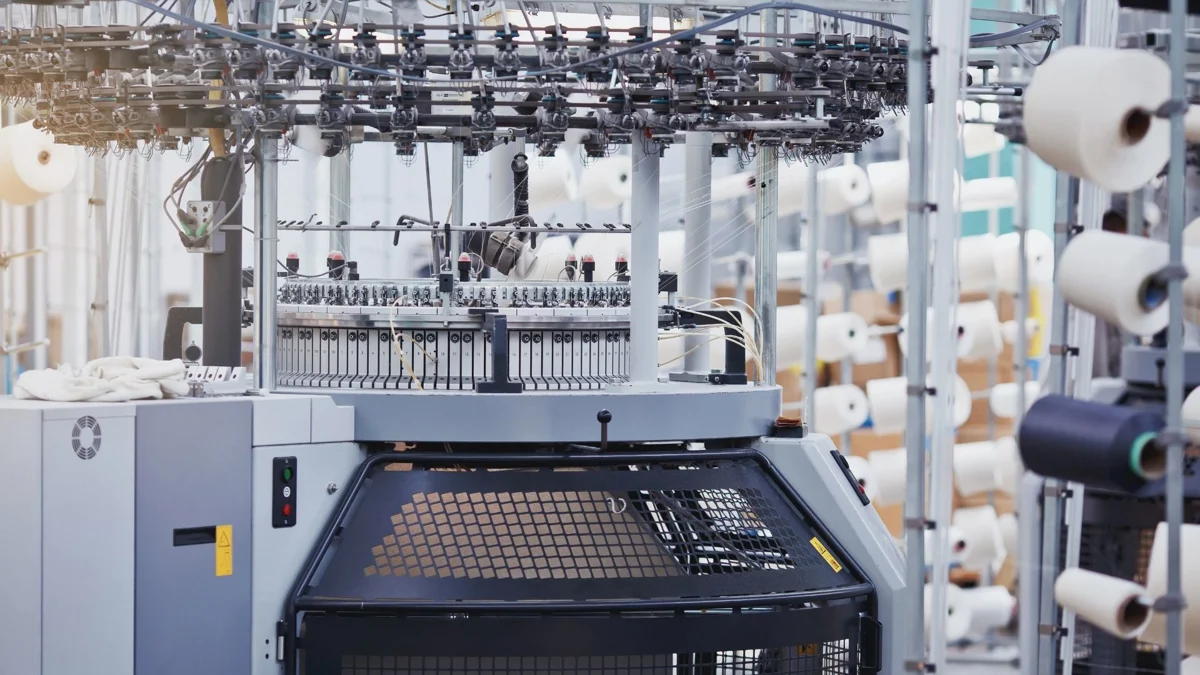
How to judge weft insertion rate on looms, gauge on knitting machines, liquor ratio on dyeing machines and stitch speed in garment production. Efficiency, electronics obsolescence risk and a full new-versus-used comparison.
In textile machinery, catalogue speed is not what decides value; real efficiency is. A loom inserting 1,000 picks per minute only matters if it runs at 92 percent efficiency. Drop to 80 percent and that same loom produces less fabric than a smaller, well-maintained machine.
Main Machine Groups and Selection Criteria
The textile chain has four links: spinning, weaving or knitting, dyeing and finishing, and garment making. Each is specified by a different metric: spindle count and yarn count range in spinning; reed width and insertion rate in weaving; needles per inch (gauge) and cylinder diameter in knitting; liquor ratio and batch size in dyeing; stitch speed and automation level in garment production.
Looms
Air-jet looms deliver the highest productivity at 800-1,200 picks per minute but consume large volumes of compressed air, which forms a significant share of running cost. Rapier looms run slower at 400-700 picks per minute but handle heavy and fancy fabrics with far more flexibility. The most common reed widths are 190 cm, 220 cm and 340 cm.
Machine Classes Compared
| Machine | Capacity | Installed power | Critical wear | Expected life |
|---|---|---|---|---|
| Air-jet loom | 800-1,200 picks/min | 4-8 kW plus air | Main nozzle, gripper | 15-20 years |
| Rapier loom | 400-700 picks/min | 4-7 kW | Rapier tape, belts | 20-25 years |
| Circular knitting (30 inch) | 15-30 kg/h | 5-9 kW | Needles, sinkers | 20 years |
| HT dyeing machine | 100-1,000 kg batch | 15-45 kW | Pump seals | 15-20 years |
| Industrial sewing machine | 3,000-5,000 stitches/min | 0.4-0.75 kW | Needle bar bearing | 10-15 years |
Used Textile Machine Checklist
- Request the total production counter and efficiency history; modern looms log it.
- Confirm that electronic boards and drives are still supported; electronics are the riskiest item in textile machinery.
- On looms, inspect reed, heald wires, weft sensors and nozzle wear.
- On knitting machines, check the needle and sinker set and cylinder surface wear; needle sets are a major consumable cost.
- On dyeing machines, test stainless body corrosion, pump performance and temperature control accuracy.
- Run a sample production and judge fabric quality against your own standards.
- Ask which yarn counts and fibres the machine has run; abrasive fibres wear machines faster.
- Budget transport, installation, levelling and commissioning from the start.
Rieter, Trützschler, Picanol, Itema, Karl Mayer, Mayer & Cie, Santoni, Monforts, Juki and Brother are the manufacturers most frequently encountered in this segment.
Cost Per Metre
- Raw material: yarn dominates fabric cost, so every point of lost efficiency is lost material.
- Energy: compressed air on air-jet weaving, steam and water heating in dyeing and finishing are the largest items.
- Water and chemicals: moving from a 1:8 to a 1:5 liquor ratio cuts water and energy consumption sharply.
- Consumables: knitting needles, healds, sewing needles and oil should be planned seasonally.
- Maintenance: daily cleaning, weekly lubrication and an annual overhaul programme preserve efficiency.
For compressed air and steam infrastructure see power and compressed air systems, and for dyehouse effluent and recovery equipment see environmental and recycling machinery.
Capacity Planning and Shift Economics
Textile capacity is calculated per product. In weaving, daily metres follow from pick density, reed width, insertion rate and efficiency. A loom with a 220 cm reed running 22 picks per centimetre at 900 picks per minute and 90 percent efficiency produces roughly 22 metres of fabric per hour. The same logic applies in kilograms for knitting, batch weight for dyeing and pieces per hour in garment production.
Shift planning shapes the investment case directly. Textile machinery carries high fixed cost, and unit cost rises quickly when the plant does not run three shifts. Machine count, order continuity and labour availability therefore have to be assessed together.
Air conditioning is another factor that affects capacity directly. If relative humidity in spinning and weaving is not held between about 55 and 70 percent, yarn breaks increase and efficiency falls. Before investing in new machines, confirm that hall humidity and temperature control are adequate, otherwise the expected output will never be reached.
Spare parts stock is what really determines downtime in textiles. Keeping critical items on site (nozzles, needle sets, sensors, belts, pump seals) prevents weeks of lost production on imported machines with long lead times. When buying used, taking over the existing spare parts stock is worth negotiating separately.
New or Used?
In textiles, electronics availability and the efficiency you target decide. New machines bring speed, lower energy use and full manufacturer support; mechanically dominated used machines let you install far more looms for the same budget.
| Criterion | New machine | Used machine |
|---|---|---|
| Initial investment | High | Substantially lower |
| Lead time | 8-30 weeks after order | Usually 1-3 weeks |
| Warranty and service | Manufacturer warranty, commissioning included | Limited or dealer warranty |
| Technology and efficiency | High insertion rate, low-energy drives, production monitoring | One or two generations behind |
| Spare parts | Secured for many years | Depends on model age |
| Depreciation | Steep loss in the first years | Much slower value loss |
| Finance and leasing | Suits leasing and incentives | Limited, needs appraisal |
A new loom or knitting machine arrives with drive and sensor hardware capable of holding efficiency above 90 percent. Production monitoring software logs stop reasons and exposes the bottleneck. In dyeing and finishing, current machines run at liquor ratios of 1:5 and below, cutting water, chemical and steam consumption sharply.
What to ask when buying new matters just as much as the used checklist:
- Lead time: the schedule from order confirmation to commissioning must be in writing.
- Warranty scope: duration, excluded parts and response time should be stated clearly.
- Service network: ask the distance to the nearest authorised service and its response time.
- Parts commitment: stock status and lead time for critical parts belong in the contract.
- Training and commissioning: confirm operator training and acceptance tests are included in the price.
Frequently Asked Questions
How is loom efficiency calculated?
Efficiency is actual picks inserted divided by theoretical picks. Modern air-jet looms are expected to run at 90-95 percent. Falling below 85 percent usually points to yarn quality, humidity and temperature conditions, or maintenance.
What does gauge mean on a knitting machine?
Gauge is needles per inch and it sets how fine the fabric can be. Roughly 18-24 gauge is used for heavy knits and 28-32 gauge for fine fabrics. Gauge cannot be changed later without replacing the needle bed and cylinder.
What is the biggest risk in used textile machinery?
Unavailable electronic boards and drives. Mechanical parts can usually be manufactured or substituted, but a discontinued control board can make an otherwise sound machine uneconomical to keep.
Why does liquor ratio matter?
Liquor ratio is the water used per kilogram of fabric. A machine running 1:5 instead of 1:8 uses roughly 35 percent less water, chemicals and heating energy for the same batch, which is one of the largest savings available in a dyehouse.
What machines does a garment workshop need?
The core set is lockstitch, overlock and coverstitch machines. Depending on product, add buttonhole, bartack and automatic pocket units. On the cutting side, an automatic cutter markedly reduces fabric waste from mid-scale production onwards.
How much efficiency does a new machine add?
Moving from an old loom running at 82 percent efficiency to a new one at 93 percent yields roughly 13 percent more output from the same number of machines. Adding the energy and waste difference, the investment repays quickly in continuous operation.
To compare new and used weaving, knitting, dyeing-finishing and garment machinery, browse the textile and garment machinery category.